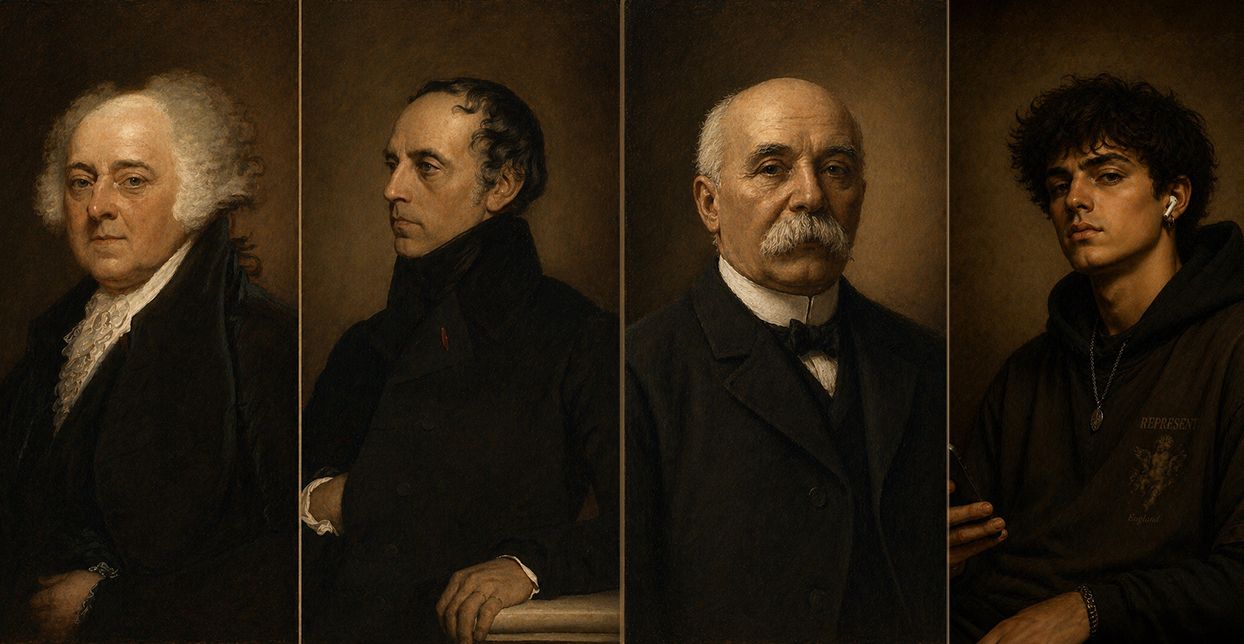
“If you aren't a communist at twenty, you have no heart. If you're still a communist at thirty, you have no head.”, said Georges Clemenceau, the French Prime Minister in early 20th century, talking about his son. The line is often misattributed to Churchill, as most things are.
Clemenceau didn’t coin the line. He pinched it. Half a century earlier, François Guizot had said the same thing about republicans in mid-19th-century France. And John Adams had beaten Guizot to it in 1799, growling that "a boy of fifteen who is not a democrat is good for nothing, and he is no better who is a democrat at twenty." Substitute the threatening ideology of your era and the line writes itself. The communist version just happens to be the one that stuck.
I promised to talk about Gen Z, but I am writing history. Why?
Look around. Everyone, from a ten-rupee mint to a Maybach, is talking about Gen Z. Whitepapers. Webinars. Decks with stock photos of unsmiling young people in oversized blazers. A particular tone of voice, half awe, half panic, afflicts the industry whenever the subject comes up, which it does all the time. They are different. They demand authenticity. They have rewritten the rules. Read enough of these and you start to suspect the rules were probably never written down at all.
This same announcement, of rectitude and revolution, in some form or other, has been made about every generation since at least Mr. Adams in 1799. Boomers were the "Me Generation”. Tom Wolfe wrote a whole essay on their narcissism in 1976. Gen X were slackers. Millennials were entitled snowflakes who arrived clutching their participation trophies.
The vocabulary changes; the song does not. The boring middle-aged with money in your client meeting today was the sleeping menace to civilisation in 1972.
A British social researcher named Bobby Duffy spent years grinding through data from three million people across forty countries and concluded (politely, and with the aid of more graphs than seems strictly necessary) that what gets sold as a generation is, more often than not, a life stage. Twenty-one is more a flavour than a cohort. Idealistic, anti-establishment, suspicious of corporations, loud about values, hungry for things to mean something.
Read the Clemenceau line again with that lens. He wasn't being clever about communism. He was being honest about twenty-two.
That is the theory. Why should it stir anything in us, apart from a slight ego bruise?
Gen Z says, in survey after survey, that sustainability matters more than the brand name. Eighty-one percent claim they will pay more for eco-friendly products. Confident. Repeated. On the record.
Meanwhile, Shein, the cathedral of fast, disposable, unmistakably unsustainable fashion, did USD 32.5 Bn in revenue last year. Up 43% from 2022. Roughly 6 in 10 Gen Z shoppers buy from ultra-fast-fashion brands every month. 40% admit they buy clothes they will wear exactly once. About 33% describe themselves, in their own words, as addicted to fast fashion.
Researchers call it the "attitude-behaviour gap." The older, simpler version: “people lie”. Mostly to themselves, occasionally to the pollster, almost always when nothing is at stake. They tell you who they want to be. Their wallet tells you who they are. The wallet wins.
And this is not a Gen Z scandal. It is a human one. The Boomer who marched against Vietnam now drives an SUV; The Gen X cynic who buys the iPhone, claims to be cynical about it. The mistake is not taking Gen Z seriously. The mistake is taking what they say more seriously than what they do.
That, perhaps, is the oldest sin in our communications/advertising industry. We are very good at listening to opinions. We are less good at watching wallets.
So what should a brand actually do? Probably ignore most of what gets said about Gen Z, including this article. Beyond that, the only suggestion that has aged well is this: do what you believe you can do well for years, and let the generations sort themselves out.
Because chasing a generation is a fool's errand. The Gen Z we are sweating over today is not the same person at twenty-eight, or thirty-four, or forty-one. Nobody has been. People change every five or six years…ten, at the most. The idea that you can catch them young and keep them for life is a fairy tale that mostly serves the people invoicing for the idea. Build something honest, useful, and a little slower than the trend, and we may find that quite a lot of these generations end up wandering in to take a look, at different ages, for different reasons, and never quite in the way the deck predicted.
The Clemenceau line has a final twist that is almost consoling. The communist at twenty doesn't disappear at thirty. He just learns to pay tax. He is still in there — slightly louder on Sundays, slightly quieter at the office — evolving the same way his parents did, with marginally better music.
There is no new species. There never has been. Just younger versions of us, with phones the rest of us don't quite understand and a vocabulary we keep mistaking for a revolution.